

Open-Frame or Canopy Generator? Understanding the Impact on RECD for DG Set Installation
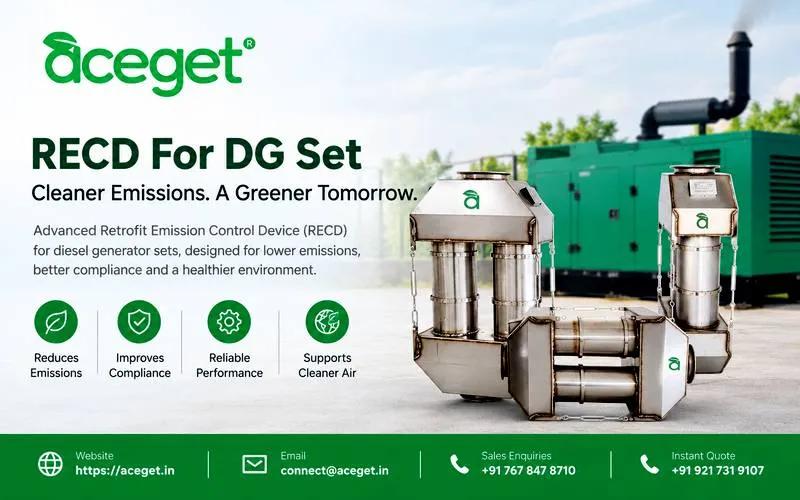

When planning emission control for a diesel generator, the discussion usually focuses on engine capacity, exhaust configuration, emission requirements and the right retrofit technology. However, one practical detail is sometimes overlooked: whether the DG set is open-frame or enclosed in a canopy.
This distinction can influence how an RECD for DG Set is planned, positioned and serviced. Although the core emission-control technology remains focused on the exhaust stream, the physical configuration of the generator can affect available space, exhaust routing, accessibility and installation work.
For businesses considering an existing generator for retrofit, understanding these differences can make the installation process smoother and help avoid unnecessary modifications.
What Is an Open-Frame DG Set?
An open-frame generator has its engine, alternator, control panel and associated components mounted on a base frame without a surrounding acoustic enclosure.
This configuration is commonly found in dedicated generator rooms, industrial facilities and other locations where the building itself provides protection from weather and external exposure.
One of its biggest advantages during retrofit work is accessibility. The exhaust system is generally easier to inspect and reach, which can simplify the planning of an emission-control installation.
Before choosing a retrofit configuration, however, the actual generator layout, exhaust dimensions, available clearances and operating conditions should be assessed.
What Is a Canopy Generator?
A canopy generator has an enclosure surrounding the generator assembly. Depending on its design, the enclosure may provide weather protection, acoustic treatment or both.
These generators are commonly used where the DG set is installed outdoors or where noise reduction is important.
The enclosure can provide several practical benefits, but it also means that any additional exhaust equipment needs to be planned around the existing canopy structure. Access doors, ventilation openings, exhaust outlets and service clearances all become relevant when installing retrofit equipment.
How Does the Generator Design Affect RECD Installation?
The purpose of an RECD is to treat emissions from an existing diesel engine. CPCB's published RECD procedure covers requirements for retrofit emission control devices used with in-use diesel-operated internal combustion engines for generator-set applications.
The generator enclosure does not fundamentally change the purpose of the RECD, but it can influence how the system is physically installed.
For example, an open-frame generator may provide relatively straightforward access to the exhaust line. An enclosed generator may require more detailed planning around the canopy exit, existing silencer arrangement and available mounting space.
This is why the generator configuration should be considered during the initial site survey rather than after the equipment has already been selected.
Open-Frame DG Sets and RECD Planning
Open-frame sets can offer several practical advantages during retrofit work.
Easier Exhaust Access
The exhaust pipe and silencer are generally visible and accessible. This can make it easier for technicians to determine where additional equipment can be integrated into the exhaust system.
More Installation Flexibility
Because there is no acoustic enclosure surrounding the engine and exhaust components, there may be more options for positioning the RECD, subject to the manufacturer's installation requirements and the certified application.
Easier Maintenance Access
Future inspection and servicing can be simpler because technicians can access the exhaust components without first working around canopy panels and restricted openings.
However, an open-frame generator installed outdoors may require additional consideration for protection of the retrofit equipment against environmental exposure.
Canopy DG Sets and RECD Planning
Canopy generators require a somewhat different approach.
The exhaust system often exits through the roof or side of the enclosure. If the RECD is installed externally, the connection between the existing exhaust outlet and the retrofit device must be properly designed.
The available space around the canopy also matters. A suitable installation should not obstruct service doors, cooling-air pathways or other essential components.
For enclosed sets, the site team may therefore need to consider:
Existing exhaust outlet location
Silencer position
Available mounting space
Canopy roof strength
Exhaust pipe routing
Service accessibility
Rainwater protection
Sensor and control connections
Future maintenance requirements
A proper assessment can help prevent the need for unnecessary fabrication changes after installation begins.
Why Exhaust Routing Matters
Exhaust routing is one of the most important considerations when installing an RECD for DG Set.
The retrofit device needs to be integrated into the exhaust system without creating unsuitable operating conditions. The complete exhaust arrangement should therefore be evaluated rather than treating the RECD as an isolated component.
For example, adding equipment to an existing canopy installation may require an adapter, modified exhaust section or additional support structure.
The exact arrangement depends on the generator model, exhaust configuration and certified RECD application.
CPCB documentation also specifies that RECDs are developed and certified for applicable engine families and defined power ranges, which makes correct device and application matching important.
Open-Frame vs Canopy: Which Is Easier for RECD Installation?
There is no universal answer because every DG installation is different.
An open-frame generator will often provide easier physical access to the exhaust system. A canopy generator may require additional fabrication or enclosure modifications, particularly where space around the exhaust outlet is limited.
That does not mean an enclosed generator is unsuitable for an RECD. It simply means the installation needs to be planned with the enclosure in mind.
The original Aceget guide on open-frame vs enclosed canopy generators explains the wider differences between these two generator configurations, including weather protection, noise, maintenance access and operating environment.
What Should Be Checked Before Selecting an RECD?
Before finalising an RECD for DG Set, a site assessment should ideally confirm several technical details.
1. Generator Capacity
The generator's rated capacity and engine specifications should be identified first. The selected retrofit device needs to be suitable for the applicable engine family and power range.
2. Engine and Model Information
Engine make, model and relevant technical details are important for determining compatibility.
3. Exhaust Configuration
The existing exhaust pipe, silencer, outlet location and available connection points should be documented.
4. Available Installation Space
Measure the area around the exhaust system and identify whether there is sufficient space for the retrofit equipment and its supporting structure.
5. Canopy Restrictions
For enclosed DG sets, check whether the canopy restricts access or requires modification for exhaust routing.
6. Maintenance Access
The installation should allow technicians to inspect and service the retrofit equipment safely in the future.
7. Environmental Exposure
Outdoor installations need additional attention to rainwater, dust, corrosion and other environmental conditions.
Why Certification and Application Matching Matter
Selecting an RECD simply because it fits the exhaust pipe is not a reliable approach.
CPCB's published information shows that certified RECDs have defined applicability across particular in-use diesel genset engine capacity ranges and engine phases.
Therefore, buyers should check the applicable certification and technical documentation for the specific generator before finalising the system.
The physical installation is only one part of a successful retrofit. The selected device must also be appropriate for the engine and application for which it is being considered.
A Practical Comparison
Factor | Open-Frame DG Set | Canopy DG Set |
Exhaust accessibility | Generally easier | May be restricted |
Installation space | Usually more flexible | Depends on canopy design |
Fabrication requirements | Often simpler | May require additional modifications |
Outdoor protection | Requires suitable site protection | Enclosure provides protection |
Maintenance access | Generally straightforward | Depends on access doors |
Exhaust routing | Easier to inspect | Requires canopy-aware planning |
RECD installation | Often simpler physically | Requires more detailed planning |
Final Considerations
The choice between an open-frame and canopy generator should not be viewed only as a question of noise or weather protection. When an existing DG set is being considered for emission-control retrofitting, the physical configuration can also influence installation planning.
An open-frame generator may provide easier access to the exhaust system, while a canopy generator can require additional attention to space, exhaust routing and enclosure modifications.
For this reason, businesses planning an RECD for DG Set should first understand the existing generator configuration and then evaluate the appropriate retrofit arrangement based on the engine, exhaust system, installation environment and applicable certification requirements.
For official technical information, buyers can also refer to the Central Pollution Control Board's RECD procedure and its published list of certified RECD manufacturers.
A well-planned retrofit is not simply about installing an emission-control device. It is about ensuring that the selected system, exhaust arrangement and generator configuration work together for reliable operation and future maintenance.